The unit of mass is the gram (g).
The kilogram (kg) is the legal unit of mass.
We note: m = 50 g
(The mass is equal to 50 grams.)
II— Units of Mass
Table of mass units: 📉
Unit
t
q
kg
hg
dag
g
dg
cg
mg
Number
1
0
0
0
Example: 1,000 kg = 1000 g
III— Taring a Balance
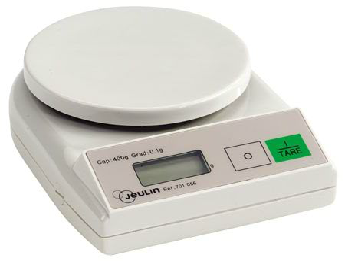
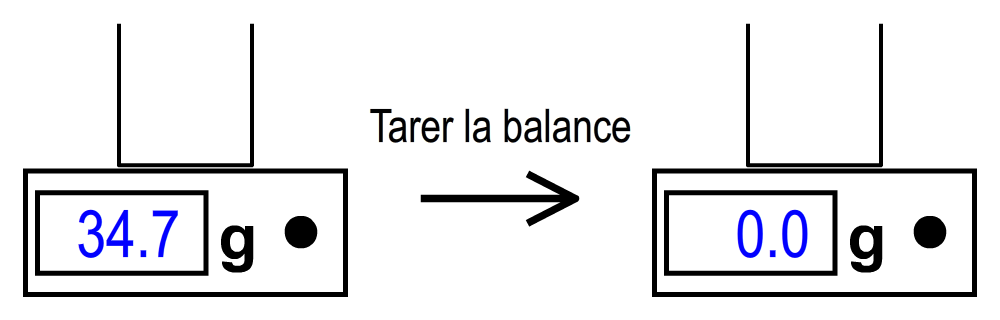
Taring a balance consists of resetting the balance display to zero by pressing the "Tare" button on the balance.
The "Tare" button on the balance can be used to cancel out the mass of a container placed on the balance or to measure out a precise mass of powder.
Diagram: Taring the balance
IV— Capacity and Precision
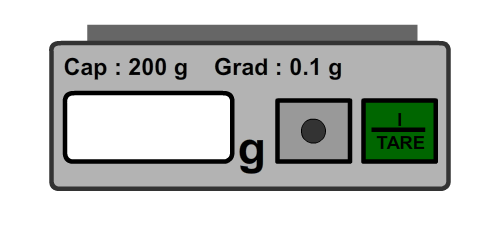
The capacity of a balance is the maximum value of the mass that the balance can measure.
The precision (or graduation) of a balance indicates the smallest difference in mass it can detect.
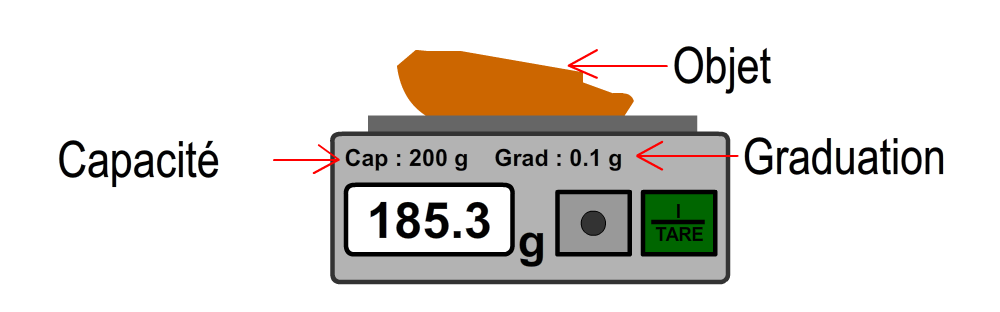
Balance 1
Graduation and capacity of a balance
This balance cannot measure the mass of objects with a mass greater than 200 g.
The precision of the balance is equal to 0.1 g.
When the balance reads 185.3 g, it means that the mass is between 185.2 g and 185.4 g or that the mass is equal to 185.3 g plus or minus 0.1 g.
We note:
m = 185.3 g ± 0.1 g
185.2 g < m < 185.4 g
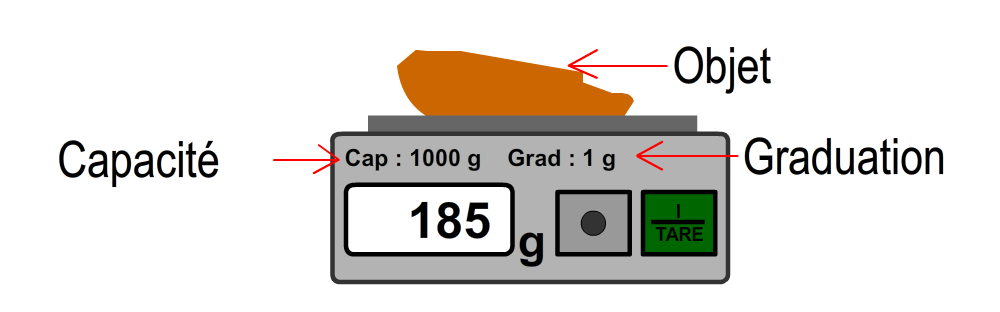
Balance 2
Graduation and capacity of a balance
This balance cannot measure the mass of objects with a mass greater than 1,000 g.
The precision of the balance is equal to 1 g.
When the balance reads 185 g, it means that the mass is between 184 g and 186 g or that the mass is equal to 185 g plus or minus 1 g.
We note:
m = 185 g ± 1 g
184 g < m < 186 g
Balance 1 is more precise than Balance 2.
Remark:
With Balance 1, we can write: m = 180.0 g
With Balance 2, we should not do this because the precision is not sufficient. Therefore, with Balance 2, we must write: m = 180 g