To determine the density ρ of air, we need:
— a balance to measure mass
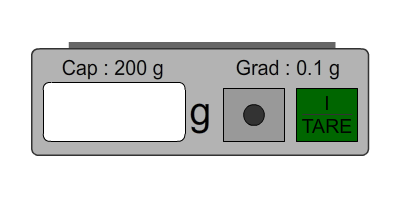
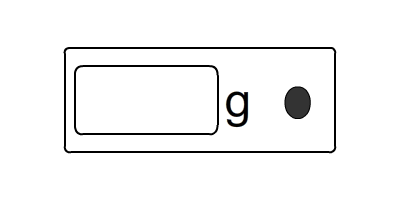
and
— a graduated container (a cylinder) or a container of known capacity (a one-litre bottle).
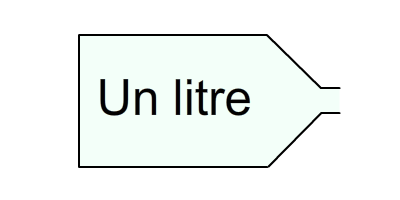
Density ρ of a liquid in g/L gives the mass in g of one litre of that liquid.
Example:
The density of carbon dioxide is
1.77 g/L
, so the mass of one litre of carbon dioxide is
1.77 g
. ✅
Density ρ is the ratio of mass m to volume V.
To determine the density ρ of air, we need:
— a balance to measure mass
and
— a graduated container (a cylinder) or a container of known capacity (a one-litre bottle).
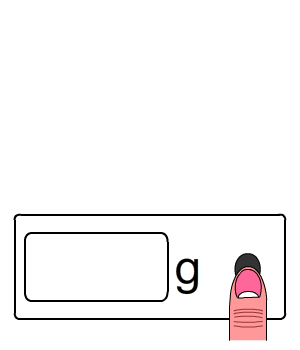

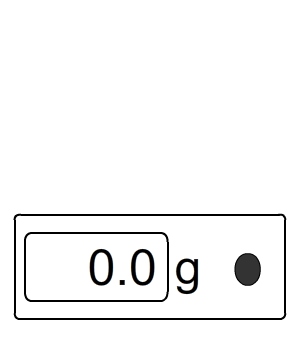

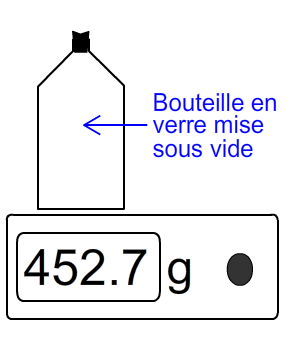

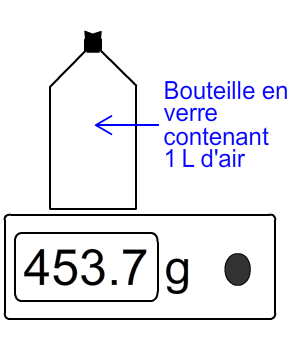
Calculation of the mass of one litre of air:
m1 = 453.7 ± 0.1 g
m2 = 452.7 ± 0.1 g
m1 L of air = m1 − m2
m1 L of air = 453.7 − 452.7
m1 L of air = 1.0 g ± 0.2 g 🎯
The mass of one litre of air is 1.0 g to within 0.2 g.
The density ρ of air is 1.0 g/L.

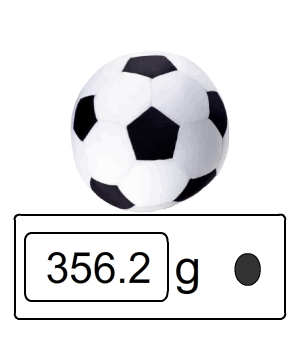

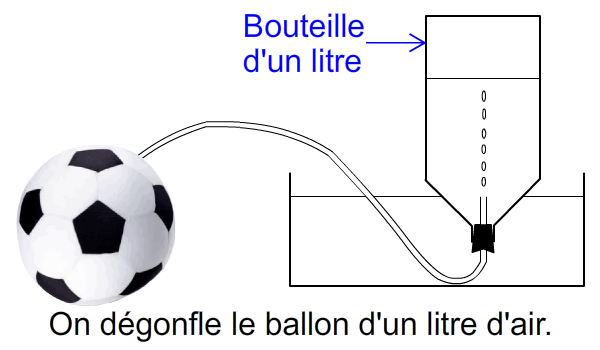

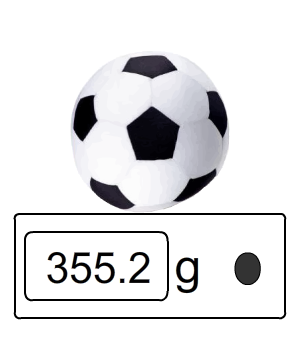
Calculation of the mass of one litre of air:
m1 = 356.2 ± 0.1 g
m2 = 355.2 ± 0.1 g
m1 L of air = m1 − m2
m1 L of air = 356.2 − 355.2
m1 L of air = 1.0 g ± 0.2 g
The mass of one litre of air is 1.0 g to within 0.2 g.
The density ρ of air is 1.0 g/L.
The density ρ of air is 1.2 g/L at 20 °C.
Note:
The density of air depends on temperature and pressure.
For a given pressure, when temperature increases, the density of air decreases.
For a given temperature, when pressure increases, the density of air increases. 🌡️➡️📉 / ⬆️🧪➡️📈
💡 Ready to test your understanding?