Mass is measured with a balance.
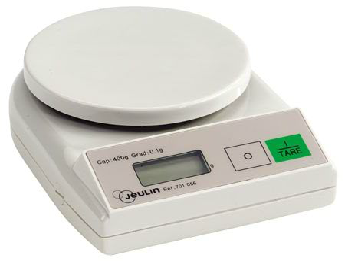 Balance ⚖️
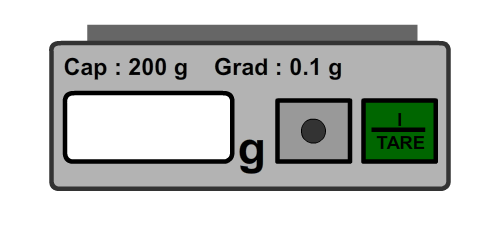 Drawing of a balance 🎨
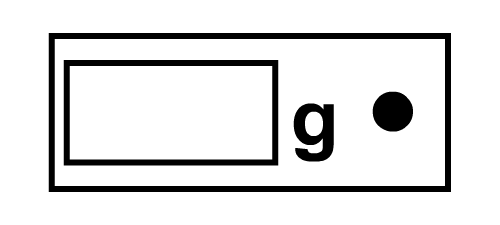 Simple diagram of a balance 📊
The legal unit of mass is the kilogram (kg).
The gram (g) is also used.
We note: m = 50 g
(The mass is equal to 50 grams.)
Volume is measured with a graduated cylinder.
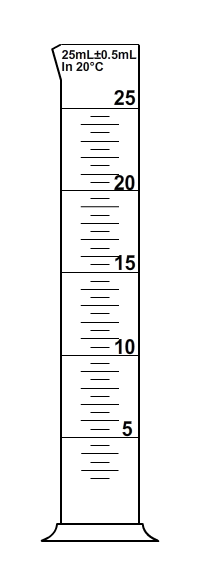 A graduated cylinder
 Cross-sectional diagram
of a graduated cylinder
The legal unit of volume is the cubic meter (m3).
The liter (L), milliliter (mL), or cubic centimeter (cm3) are also used.
We note: V = 100 mL
(The volume is equal to 100 milliliters).
The density ρ of a liquid in g/L indicates the mass in grams of one liter of that liquid.
Example:
The density of alcohol is equal to 789 g/L, so the mass of one liter of alcohol is equal to 789 g.
Density is equal to the ratio of mass to volume.
\( \bbox[5pt, white]{ρ = m \div V} \)
\( \bbox[5pt, white]{ρ = m : V} \)
\( \bbox[5pt, white]{ρ = m\,/ V} \)
\( \bbox[5pt, white]{ρ = {\displaystyle\frac{m}{V}}} \)
The legal unit is the kilogram per cubic meter (kg/m3).
The g/L or g/cm3 are also used.
With m in grams (g) and V in liters (L), we obtain ρ in g/L.