Sugar is soluble in water.
When you pour a little sugar into water, you get a homogeneous mixture.
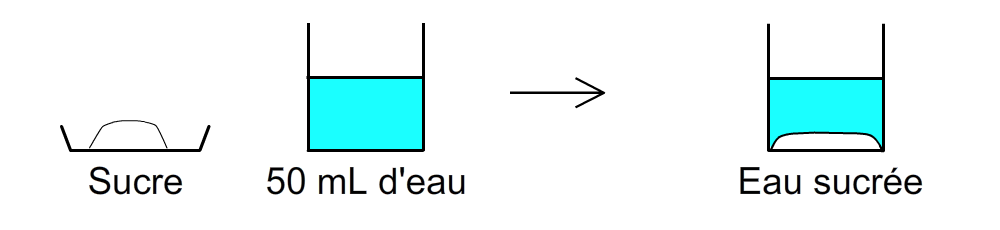
With a lot of sugar, you can get a heterogeneous mixture.
The solution is saturated with sugar.
It can no longer dissolve sugar.
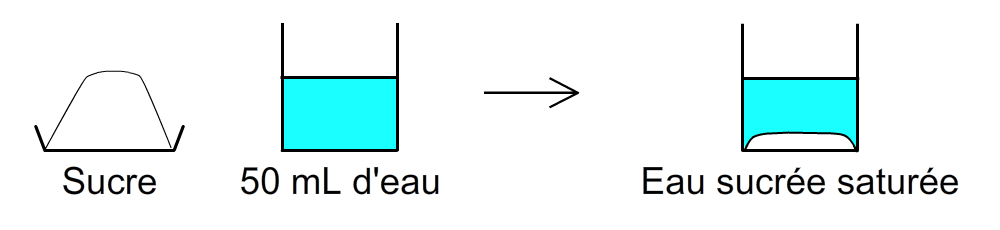
A saturated solution is a solution that can no longer dissolve solute.
Solubility s is equal to the maximum mass of solute that can be present in one liter of solution.
Solubility s is equal to the ratio of the maximum mass of solute to the volume of the solution.
Solubility is expressed in g/L.
With m in grams (g) and V in liters (L).
Method:
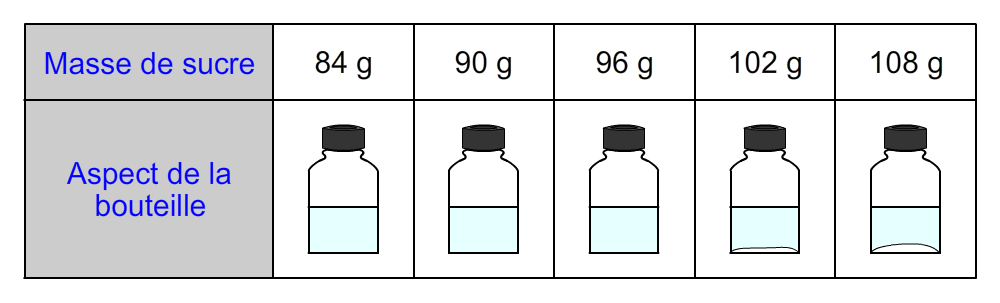
In 50 mL of water, you can dissolve between 96 g and 102 g of sugar.
\( \bbox[5pt, white]{s = {\displaystyle\frac{m_{\text{solute}}}{V_{\text{solution}}}}} \)
with 96 g < m < 102 g and V = 50 mL = 0.05 L
\( s = \displaystyle\frac{96}{0.050} = 1,920 \, \text{g/L} \)
\( s = \displaystyle\frac{102}{0.050} = 2,040 \, \text{g/L} \)
The solubility of sugar is between 1,920 g/L and 2,040 g/L.